Showing posts with label K-6. Show all posts

November 22, 2017

Bananagrams Tiles and Book for Kids

Fun Combination of Word Games and Puzzles

Bananagrams, the letter-tile game that is similar to Scrabble, is the better game in my opinion because of its fast pace. Players don't need to wait for their turns to come around. They just keep playing until they run out of tiles.

Games go in and out of favor in my family, so Bananagrams had been gathering dust recently. But then a few days ago, my ten-year-old brought the Banagrams for Kids book home. It has fun word puzzles at several levels of difficulty. This book, along with the tiles, has become our pre-bedtime play for the past few days. We are not about to quit.


I like that it naturally teaches vocabulary, spelling and chunking skills with letters and words--all through play.

Level One Puzzle
Level Four Puzzle
The game-and-book set would make a great Christmas gift if you want to make learning fun for your kids. If you have the letter tiles, you don't need to write in the book.


What kind of word games do you play with your children or students? Share in the comments!

October 31, 2013

Ordinal Number Fun - Baseball Lineup Card

Teach with your student's interests in mind.  My first-grade son likes baseball, so when we did ordinal numbers (1st, 2nd, 3rd...), he made his own lineup card. I'm not sure I agree with his batting order decisions but hey, it's math practice, not baseball manager practice.


October 16, 2013

Work While You Work - Poem Study

"Work" is another old, anonymous poem introduced in First Language Lessons for the Well-Trained Mind but with slightly different words. It speaks directly to the modern condition of multitasking and continuous partial attention. We would all do well to heed its advice.


 Work while you work
  Play while you play;
One thing each time,
  That is the way.
All that you do,
  Do with your might;
Things done by halves
  Are not done right.

"Work" has a snappy meter and a simple rhyme scheme. More than anything else though, the meaning of the words is what makes this poem worth studying. Work and play are equally valuable, but each must be done at its proper time and with all of one's might.

Working "Work" Through the Curriculum


Bible: Talk about similarities between the poem and Colossians 3:23. "And whatsoever ye do, do it heartily, as to the Lord, and not unto men." (KJV)

Math: Discuss the idea of doing things "by halves."

Life Skills: Help your child plan out a day on the calendar. Be sure to schedule some "work" time and some "play" time.

Music: March or drum to the poem. It has a very regular rhythm and each of the words has just one syllable.

I've also written poem study guides for Christina Rossetti's "The Caterpillar,"  the anonymous "Mr. Nobody," and "Hearts Are Like Doors." Please check them out, and feel free to leave a comment below. Also, check out the other posts on Trivium Tuesdays.

September 26, 2013

Poem Study: "Hearts Are Like Doors"

Here's another poem from First Language Lessons for the Well-Trained Mind. It's an old, anonymous rhyme called "Hearts Are Like Doors."

photo by Jorge Diaz
Hearts, like doors, will open with ease,
To very, very little keys,
And don't forget that two of these
Are "Thank you, sir" and "If you please!"


Similes and Metaphors

When I teach this poem, I talk about similes and metaphors. The first line relates hearts to doors using the word "like." This is a straightforward simile. A simile is a figure of speech that rhetorically transfers aspects of one word to another, using "like," "as," or another similar word. A metaphor, like a simile, compares or relates unlike words, but it doesn't necessarily utilize a comparing word such as "like." You could say that all similes are metaphors, but not all metaphors are similes.

The other metaphor in "Hearts Are Like Doors" is harder to pick out. "Thank you, sir" and "If you please" are two of the little keys that can open a heart.

Young children can learn about similes and metaphors, but have a hard time using them skillfully at first. My little guy started with "That wall is white like this table." Not bad, but few people reading this sentence know how white our table or wall is.

To help your child understand these figures of speech, try starting a simile and asking your child to finish it: "As cold as ___." As fast as ___." The clouds are like ___." If you need some inspiration, here is a pdf simile worksheet. You have to register to get rid of the nag screen, but you can see enough to get some ideas.


Other Teaching Points

  • Manners: Brainstorm other polite "keys" that can open people's hearts.
  • Punctuation and Phrasing: Observe and punctuation provided in the poem. "To very (pause) very little keys." There is no punctuation at the end of the third line. The "these" rhyme is enough to indicate the end of the like. There is no need to pause.
  • Bible Connection: In Revelation 3:20, Jesus says, "Behold, I stand at the door and knock. If anyone hears my voice and opens the door, I will come in to him and eat with him, and he with me." The door in this passage is often thought of as a person's heart door.
I've also written poem study guides for Christina Rossetti's "The Caterpillar" and the anonymous "Mr. Nobody." Please check them out, and feel free to leave a comment below.

September 16, 2013

Number Line Addition Game with Dice

A friend told me the other day that her first-grade son was discouraged about math. He is having a hard time memorizing addition and subtraction facts within 10. He was calling himself stupid and saying that he was no good at math. How sad to see a little guy developing a math complex.

Anyway, she asked me for some tips. I shared with her a game that I had played earlier in the week with my own son. It's great practice for addition facts within 10, especially plus 1, plus 2, and plus 3, but can be adapted easily to subtraction or to numbers up to 20. It's from Singapore Math's Primary Mathematics 1A (affiliate link).

Materials
  • A number line 0-10 (or 0-20) with squares big enough for game tokens. (We
    Post-It Notes Turn Dice into Math Dice
    used Professor Plum and Colonel Mustard from Clue.)
  • Game tokens.
  • A die (number cube) with stickers (two each) labeled +1, +2, and +3 stuck onto the sides. Depending on the skill you want to target, you can replace the stickers with -1, -2, -3, or whatever.
Procedure:
  • Each players token starts at zero for addition or ten for subtraction.
  • Players take turns rolling the die and moving their tokens up the number line by the amount shown on the die. For example, if they are on 2 and roll a +3, they say "Two plus three equals five."  If a player lands on another player's spot, the other player's token goes back to the beginning. 
  • The first player to reach the goal wins the game, or a point. If a player overshoots the goal, the player's token goes back to the beginning. 
 You can draw your own number line, or use my simple 0-10 or 0-20 printable number lines (pdf).

Do yo have any recommendations for fun ways to practice math facts? Share in the comments.


September 6, 2013

Go Fish! Number Bonds Version

Our youngest is doing Singapore Math 1 this year and is learning number bonds now. Number bonds, are simply sets of three numbers—two parts and a whole—that go together, like 3, 2, and 5. They are usually represented something like this:

When children learn this one number bond, it becomes easy for them to memorize the fact family 3+2=5, 2+3=5, 5-3=2, and 5-2=3. It also helps later to be able to break numbers down to make them easier to work with.

On to the game. My little guy brought out his set of Go Fish cards last night after dinner and we decided to play "Go Fish to Make 10." (We could have decided to make any number.) You've probably got the idea already, but instead of fishing for pairs of identical cards, you fish for pairs that make 10. For example, if you have a 3 in your hand, you ask for a 7. Don't forget before playing to pull the cards out of the deck that won't work. Last night we had to take out the 11s and 12s.


Above is the Numbers Go Fish Game that we have [amazon affiliate link]. The cards are large and sturdy, the numbers are clear, and the pictures are interesting. A regular deck of playing cards works fine too, but I like having zeros and ones (not aces).

It's nice to have another game to practice number bonds and fact families. I've previously written about others like Salute, Eleven, and Number Bonds Dominoes. All you need for these games is a deck of cards or some dominoes. Please share your favorite ways to practice number bonds in the comments area below!

August 30, 2013

Poem Study: "The Caterpillar" by Christina G. Rossetti

Christina Rossetti's "The Caterpillar" is a wonderful first poem for a child to memorize and study. It is short, simple and concrete, yet contains many poetic and literary elements that even a child can grasp easily. I'll share them below.

photo by Cyndy Sims Parr

First, the poem itself:

Brown and furry
Caterpillar in a hurry,
Take your walk
To the shady leaf, or stalk,
Or what not,
Which may be the chosen spot.

No toad spy you,
Hovering bird of prey pass by you;
Spin and die,
To live again 
A butterfly.

A shorter version of the poem appears in the excellent First Language Lessons for the Well-Trained Mind: Level 1 and in several places online. Here it is:

Brown and furry
Caterpillar in a hurry,
Take your walk
To the shady leaf, or stalk.

May no toad spy you,
May the little birds pass by you;
Spin and die,
To live again a butterfly.

I think either version is fine. The first one seems to be the poet's original, the second a later simplification, but on to the study!

First, read the poem several times and just enjoy the words and images. The poem is very concrete and accessible; everyone has seem a caterpillar inch along. Everyone has seen toads and birds. Reading and enjoying "The Caterpillar" might be enough, but there is so much more to gain from this little poem.

Notice the rhyme scheme. Rossetti writes in couplets (including the two-word units "spy you" and "by you!").

Notice the punctuation. The first two lines contain no commas within or between the lines. The caterpillar is hurrying and so should the reader. Don't pause between the first and second lines. Then there is a comma between the "shady leaf" and the "stalk." Pause with the caterpillar as it ponders two possible places for its chrysalis.

Notice the line length. The lines alternate between short and long, like the scrunch-up-and-stretch-out motion of a caterpillar or inchworm.


Notice the Christian Imagery. In addition to her poetry for children, Rossetti wrote a lot of devotional poems. The butterfly is a common Christian symbol for resurrection. The caterpillar appears to die when it becomes a chrysalis and returns glorious as a butterfly. "Spin and die to live again a butterfly" on one level is about a caterpillar spinning its cocoon, but on another level, it might refer to a spinster who appears to have missed her opportunity on earth, but will be resurrected gloriously in heaven. (Rosetti had a series of suitors, but never married.) This point may be over the heads of children, but the best children's poetry also works for adults.

What else do you enjoy about "The Caterpillar?" Do you have a favorite poem to study with children? Please share in the comments!

You may find similar articles to this at Trivium Tuesdays.
August 19, 2013

It's Monday! What are you reading 8/19/2013


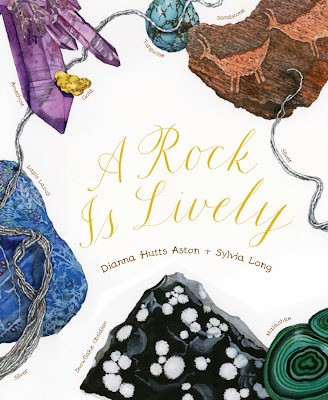
There's a children's book exhibition on in my town and one book that caught my eye was A Rock Is Lively by Diana Hutts Aston and Sylvia Long (affiliate link).

The illustrations are bright and beautiful. The text is hard to classify.

Is it poetry? "Bubbling like a pot of soup deep beneath the Earth's crust ... liquid ... molten ... boiling"

Is it geology? "Depending on what type of rock it is, a rock melts at temperatures between 1,300 and 2,400 degrees Fahrenheit ..."

 However you categorize this book, the illustrations and poetic writing will satisfy your artistic side while the informative text will thrill your inner rockhound.

A Rock Is Lively Cover

August 5, 2013

Anti-Pattern Recognition

Math is largely about recognizing and creating patterns. But sometimes the best way to practice something is doing the opposite. Hmmm. Is avoiding a pattern another way of creating a pattern?
Take from a deck of cards all the Aces, Kings, Queens and Jacks.

Arrange them in a 4 × 4 square so that every row, column and diagonal contains one card of each value (A,J,Q,K) and one card of each suit (Heart, Spade, Diamond, Club). source
It's really tough not to have cards of the same value or suit in any row, column, or diagonal, but look at the sense of accomplishment on the faces of these ten-year-olds who stuck with it and solved the puzzle.


June 27, 2013

Four Fours and Making Math Fun

Today I gave my kids the "four fours" challenge. Here it is:

Find a mathematical expression for all the numbers from zero to twenty using common symbols (+, -, x, ÷, √, and !), parentheses, and exactly four 4s. The simpler the expression, the better.

To get you started:
4x4÷4-4=0
4x4÷4÷4=1

I had to teach my daughter what √4 and 4! mean. She was very motivated to learn them because they were a great tool to solve the challenge.

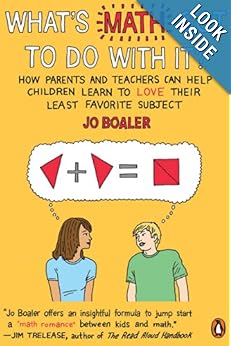
It turns out that "four fours" is a common challenge, but I found it in Jo Boaler's excellent What's Math Got to Do with It?: How Parents and Teachers Can Help Children Learn to Love Their Least Favorite Subject (amazon affiliate link). The book is full of research-backed suggestions for parents and teachers to help their kids thrive in math. Dr. Boaler will be teaching a course called "How to Learn Math" on Stanford University's free online platform. It's from July 15 to September 27, 2013. You can find out more about it here. I'll be taking the course. Please let me know if you will be.

June 19, 2013

Student-Created Math Questions

Student assessment can take many forms. One thing I like to do is ask the students to create their own questions, answer them themselves, and share the questions with others.

The raw material I gave the students is from the well-known "Eric the Sheep" problem (Here's another blog about it).

Eric the sheep is lining up to be shorn. He is last in the line. Each time the shearer takes one sheep from the front of the line, Eric sneaks past two sheep to get closer to the front. There are 50 sheep in front of Eric to start with. It takes the shearer ten minutes to take a sheep from the line and shear it. The shearer never takes a break! Each sheep produces 5 kg of wool.

Use the information in the story of Eric the sheep to make up an interesting story problem that you can answer. You don't need to use all of the information.
And here are my students' questions with the their ages (I teach a multi-age class). I had to help a few students polish their questions to get rid of excessive wordiness or vagueness.

1. How many times does Eric pass two sheep? (10 year-old)

2. How many minutes does it take to pass 24 sheep? (10 year-old)

3. After 60 minutes, what place was Eric in? (10 year-old)

4. How many kilograms of wool did all of the sheep provide? (8 year-old)

5. What number is Eric to be sheared? (11 year-old)

6. How many grams of wool were sheared altogether? (11 year-old)

7. How much wool is sheared before Eric is sheared? (12 year-old)

8. How many sheep did Eric pass? (12 year-old)

9. How long does the shearer shear before shearing Eric? (12 year-old)

10. If Shawn, who started at number 34, skips one sheep every time the shearer takes a sheep, who arrives to the front of the line first, Shawn or Eric? (12 year-old)

11. One-third of the sheep are pink, two-sixths of the sheep are vomit green, and the rest are purple. (a) How many purple sheep are there, and (b) how many kilograms of purple wool were there? (13 year-old)

These questions cover all the types of questions I would have asked and then some (number 10!). Some of the students missed their own questions on the first try, but were very motivated to find the correct answer.

This kind of activity is excellent assessment for learning. We can see what the students are and aren't comfortable with, and we can be sure that if their answer is incorrect, it certainly can't be because they misunderstood the question. After all, they wrote it!


May 23, 2013

Over 100 Words in Signature

Today my students found over 100 words hiding in the word "signature." Most of the kids are English language learners. It was a fun way for them to think about spelling and learn some new vocabulary.

It all started with me pointing out that the word "sign" is the root of "signature," which is a spelling word for some kids this week. A student pointed out that the word also contains "gnat." Someone else found "nature," and we were off to the races.

Right after taking this photo, a student found "granite." Can you find any other words? Add them in the comments.

Over 100 words in "signature"

December 9, 2012

20 Foods to Learn Fractions

The most fun and delicious way to learn fractions is with food. You can count, add, subtract, even multiply and divide fractions with food. We've all studied fractions with halves and quarters of apples, but how about these other foods? Some foods can be cut into fractions easily. Others are already in sections. Still others come in bunches.
  1. Pizza
  2. Pie
  3. Quesadillas
  4. Orange wedges
  5. Graham crackers
  6. Bunches of grapes
  7. Bunches of bananas
  8. Chocolate bars
  9. M and Ms
  10. Heads of cabbage or lettuce
  11. Pancakes
  12. Waffles
  13. Popsicles
  14. Cookies
  15. Six-packs of juice or soda
  16. Bell peppers
  17. Marshmallows
  18. Animal crackers
  19. Jelly beans
  20. Packs of candy or gum
Enjoy learning fractions! And Bon Apetit!

Feel free to add more foods in the comments.

Photo of Orange by Esther Gibbons on Flickr (CC BY-ND 2.0)

November 29, 2011

Draw... Then Write: Workbook for Reluctant Writers

Struggling to motivate a reluctant writer?
I bought Draw...Then Write a few years ago to use with my English language learners. Since then, it's been great, not only for ELLs, but also for native English speakers who are reluctant to write or just need a little prompt to get the creative juices flowing.

The concept behind Draw... Then Write is simple. Students are given easy, step-by-step instructions for drawing high-interest objects--mostly animals, people, and vehicles. The drawings are so simple that no child will fail and not too much time will be spent drawing at the expense of writing.  The students' drawings become the basis for fun writing activities. Each drawing has writing prompts at three levels of difficulty to facilitate differentiated instruction. The activities range from completing sentences with a choice of preselected words, through brainstorming and writing sentences, all the way to composing complete paragraphs.

I make copies of the (legally reproducible) pages for my students, but the drawings are so simple that I could see a teacher copying them by hand on a whiteboard and prompting writing that way. My Draw... Then Write book is recommended for grades one through three. There is also a version of Draw... Then Write for grades four through six, which I have not used. See sample pages for both books on amazon.

Do you have a favorite way to motivate reluctant writers? Please share in the comments.

November 23, 2011

Make a Paper Bowl

The Chinese invented paper over 4000 years ago. For our unit on ancient China, we made our own paper bowls in the classroom last week. The main things you need are construction paper, newsprint, water, a blender, and a kitchen sieve. For step-by-step instructions with lots of photos, check out my How to Make a Paper Bowl page.

June 14, 2011

50 Fine Motor Skills Activities for Older Children

Fine motor skills are crucial for everyone, but focused practice on them usually ends in preschool or kindergarten. Older children often need a little more work, especially to increase the legibility of their handwriting, but just practicing penmanship is boring. How can working on fine motor skills be fun?

Here are some fun activities to improve fine motor skills. Of course everyone has different different likes and dislikes, so to make sure there are at least a few choices to suit everyones interests, I present fifty fine motor skills activities for older children.

Crafts for Fine Motor Skills
Improve eye-hand coordination with crafts

Origami Blue Bird by Jacque Davis
1. Stringing beads

2. Origami

3. Cloth or paper embroidery

4. Crocheting or knitting

5. Fusion beads (tip: use tweezers for even better fine motor skills practice)

6. Paper cutting (the art form, not the preschool activity)

7. Aqua Beads (like fusion beads, but you spray water on the beads to make them stick together instead of an iron)

8. Basket weaving

9. Sewing

10. Pottery

Games for Fine Motor Skills
Add some competition

Jenga Tournament by Tom Rolfe
11. Operation

12. Jenga

13. Make 'n' Break (see my review)

14. Yahtzee

15. Foosball

16. Rush Hour

17. Marbles

18. Darts

19. Play dough charades

20. Video games (hate to admit it, but they do improve eye-hand coordination and fine motor skills.)

Puzzles to Help Fine Motor Skills
Engage the brain too
Playing with Brain String Advanced

21. Mazes

22. Jigsaw puzzles

23. Rubik's Cube and other similar puzzles

24. Crossword Puzzles

25. Brain String Advanced (see my review)

25 More Fine Motor Skills Activities for Older Children
Something for everyone

26. Enjoy coloring (not just for kids)

27. Practice a musical instrument

Use Chopsticks for fine motor skills
28. Use chopsticks

29. Tie flies

30. Go fishing

31. Try writing Japanese or Chinese characters (see my ideas for learning Japanese)

32. Learn how to tie cool knots

33. Practice typing/keyboarding

34. Play with Wikki Stix (see my Wikki Stix review)

35. Learn sign language

36. Sculpt with clay

37. Do paper mache

38. Make plastic models

39. Play with gears

40. Braid hair

41. Build with Lego

42. Decorate cakes

Magnetic Sculpture by Tamra Hays
43. Make magnetic sculptures

44. Play paper football

45. Make designer lattes and cappuccinos

46. Play with a tilting ball maze

47. Do a connect-the-dots puzzle

48. Learn calligraphy

49. Make a mosaic

50. Write with a fountain pen

Question: Do you have a favorite fine motor skills activity for older children? Please share in the comments!

February 11, 2011

Brain String Advanced - Fun 3D Spatial Reasoning Puzzle

Whoever thought untying knots could be so much fun? Improve your sense of spatial relations with Brain String Advanced, a fun puzzle that, like all good logic games, is strangely addictive. It's a tetrakaidecahedron (14-sided geometric solid) with colored elastic cords running through the middle of it. The goal is to get cords of the same color each surface without any tangles in the middle. As you can see in the video below, it isn't easy.


This puzzle is a great tool to improve spatial reasoning, plan several steps ahead, and think through what unintended consequences an action may trigger. It can be solved by lots of trial and error, but in the process, you begin to see more and more steps ahead in untangling the knot.


My ten-year-old son received this puzzle from his grandparents, and we have been fighting over it ever since.
Brain String Advanced - Solved!

January 15, 2011

Blink - Fun Card Game for Learning

My oldest child received "Blink - The World's Fastest Card Game" for his tenth birthday last year. It sat on a shelf for a while, but we recently started playing it and have gotten hooked. Like it says on the box, Blink takes less than two minutes to play, so it's perfect for those in-between times.

From the product description on amazon.com:
This game is a clever variation on the classic card game, Spit. As cards are turned face up on the table, you must try to get rid of the cards in your draw pile by matching at least one characteristic on the card (color, shape, or count). These cards are colorfully designed with stars, moons, triangles, and more. You can only have three cards in your hand at one time, but may continue to pick cards from your draw pile as soon as you discard. Includes 60 Symbol cards and instructions. 
Educational Benefits of Blink Card Game
As a teacher, here's what I like.
  • Children have to think about three attributes of their cards, color, shape, and count.
  • It's great for working memory. Players need to keep in mind the attributes of their cards and the the ones on top of the discard pile.
  • Children learn to make quick decisions under pressure, but the pressure is harmless.
  • Unlike a regular deck of playing cards, if you lose a few it doesn't really matter.
  • It's easy to handicap the faster players to keep the game competitive; just deal them more cards than the slower players.

More Card Games for Learning
Read about how to teach math with UNO.

January 14, 2011

Cloud in a Glass

We found a simple weather experiment online and tried it at home this morning. The idea is to make water condense in a glass to simulate cloud formation. You fill a glass about a quarter full with warm water and place an ice cold metal dish on top. The water vapor in the warm moist air trapped in the glass is supposed to condense as it cools near the cold dish and form a cloud.

Our first attempt didn't work. I think the problem was a combination of the water not being warm enough and a gap where the rim of the glass and the bottom of the bowl met.

First try. No cloud, just some condensation on the bottom of the bowl.
So we tried again. This time we heated the water more and put it in a different cup, one that we hoped wouldn't have a gap. We heated the water too much because the water was steaming even before putting the cold dish on top. The glass immediately fogged up with condensation and we couldn't see whether a cloud was forming inside or not. Steam escaped through the gap again.

Second try. The water was so hot that it immediately fogged up the glass.
So we tried a third time. We let the water cool a little and covered the glass with plastic wrap so no water vapor could escape. We put the ice on the wrap and watched the condensation happen. Again, no visible cloud inside the glass.

Third try. We definitely saw condensation, but no cloud.
 This experiment turned out to be a good one for the kids to learn that whatever the expected outcome, good scientists don't fudge their results. Instead, they learn from what they observe and think about how to structure the experiment better next time. We did observe condensation when hot moist air met cooler air, and the kids could visualize how clouds would form. Here are their write-ups.