Today I gave my kids the "four fours" challenge. Here it is:
Find a mathematical expression for all the numbers from zero to twenty using common symbols (+, -, x, ÷, √, and !), parentheses, and exactly four 4s. The simpler the expression, the better.
To get you started:
4x4÷4-4=0
4x4÷4÷4=1
I had to teach my daughter what √4 and 4! mean. She was very motivated to learn them because they were a great tool to solve the challenge.
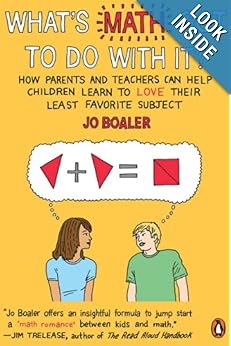
It turns out that "four fours" is a common challenge, but I found it in Jo Boaler's excellent What's Math Got to Do with It?: How Parents and Teachers Can Help Children Learn to Love Their Least Favorite Subject (amazon affiliate link). The book is full of research-backed suggestions for parents and teachers to help their kids thrive in math. Dr. Boaler will be teaching a course called "How to Learn Math" on Stanford University's free online platform. It's from July 15 to September 27, 2013. You can find out more about it here. I'll be taking the course. Please let me know if you will be.
Showing posts with label Middle School and Up. Show all posts
June 27, 2013
June 19, 2013
Student-Created Math Questions
Student assessment can take many forms. One thing I like to do is ask the students to create their own questions, answer them themselves, and share the questions with others.
The raw material I gave the students is from the well-known "Eric the Sheep" problem (Here's another blog about it).
These questions cover all the types of questions I would have asked and then some (number 10!). Some of the students missed their own questions on the first try, but were very motivated to find the correct answer.
This kind of activity is excellent assessment for learning. We can see what the students are and aren't comfortable with, and we can be sure that if their answer is incorrect, it certainly can't be because they misunderstood the question. After all, they wrote it!
The raw material I gave the students is from the well-known "Eric the Sheep" problem (Here's another blog about it).
Eric the sheep is lining up to be shorn. He is last in the line. Each time the shearer takes one sheep from the front of the line, Eric sneaks past two sheep to get closer to the front. There are 50 sheep in front of Eric to start with. It takes the shearer ten minutes to take a sheep from the line and shear it. The shearer never takes a break! Each sheep produces 5 kg of wool.And here are my students' questions with the their ages (I teach a multi-age class). I had to help a few students polish their questions to get rid of excessive wordiness or vagueness.
Use the information in the story of Eric the sheep to make up an interesting story problem that you can answer. You don't need to use all of the information.
1. How many times does Eric pass two sheep? (10 year-old)
2. How many minutes does it take to pass 24 sheep? (10 year-old)
3. After 60 minutes, what place was Eric in? (10 year-old)
4. How many kilograms of wool did all of the sheep provide? (8 year-old)
5. What number is Eric to be sheared? (11 year-old)
6. How many grams of wool were sheared altogether? (11 year-old)
7. How much wool is sheared before Eric is sheared? (12 year-old)
8. How many sheep did Eric pass? (12 year-old)
9. How long does the shearer shear before shearing Eric? (12 year-old)
10. If Shawn, who started at number 34, skips one sheep every time the shearer takes a sheep, who arrives to the front of the line first, Shawn or Eric? (12 year-old)
11. One-third of the sheep are pink, two-sixths of the sheep are vomit green, and the rest are purple. (a) How many purple sheep are there, and (b) how many kilograms of purple wool were there? (13 year-old)
These questions cover all the types of questions I would have asked and then some (number 10!). Some of the students missed their own questions on the first try, but were very motivated to find the correct answer.
This kind of activity is excellent assessment for learning. We can see what the students are and aren't comfortable with, and we can be sure that if their answer is incorrect, it certainly can't be because they misunderstood the question. After all, they wrote it!
June 14, 2011
50 Fine Motor Skills Activities for Older Children
Fine motor skills are crucial for everyone, but focused practice on them usually ends in preschool or kindergarten. Older children often need a little more work, especially to increase the legibility of their handwriting, but just practicing penmanship is boring. How can working on fine motor skills be fun?
Here are some fun activities to improve fine motor skills. Of course everyone has different different likes and dislikes, so to make sure there are at least a few choices to suit everyones interests, I present fifty fine motor skills activities for older children.
Crafts for Fine Motor Skills
Improve eye-hand coordination with crafts
1. Stringing beads
2. Origami
3. Cloth or paper embroidery
4. Crocheting or knitting
5. Fusion beads
(tip: use tweezers for even better fine motor skills practice)
6. Paper cutting (the art form
, not the preschool activity)
7. Aqua Beads
(like fusion beads, but you spray water on the beads to make them stick together instead of an iron)
8. Basket weaving
9. Sewing
10. Pottery
Games for Fine Motor Skills
Add some competition
11. Operation
12. Jenga
13. Make 'n' Break
(see my review)
14. Yahtzee
15. Foosball
16. Rush Hour
17. Marbles
18. Darts
19. Play dough charades
20. Video games (hate to admit it, but they do improve eye-hand coordination and fine motor skills.)
Puzzles to Help Fine Motor Skills
Engage the brain too
21. Mazes
22. Jigsaw puzzles
23. Rubik's Cube
and other similar puzzles
24. Crossword Puzzles
25. Brain String Advanced
(see my review)
25 More Fine Motor Skills Activities for Older Children
Something for everyone
26. Enjoy coloring (not just for kids)
27. Practice a musical instrument
28. Use chopsticks
29. Tie flies
30. Go fishing
31. Try writing Japanese or Chinese characters (see my ideas for learning Japanese)
32. Learn how to tie cool knots
33. Practice typing/keyboarding
34. Play with Wikki Stix
(see my Wikki Stix review)
35. Learn sign language
36. Sculpt with clay
37. Do paper mache
38. Make plastic models
39. Play with gears
40. Braid hair
41. Build with Lego
42. Decorate cakes
43. Make magnetic sculptures
44. Play paper football
45. Make designer lattes and cappuccinos
46. Play with a tilting ball maze
47. Do a connect-the-dots puzzle
48. Learn calligraphy
49. Make a mosaic
50. Write with a fountain pen
Question: Do you have a favorite fine motor skills activity for older children? Please share in the comments!
Here are some fun activities to improve fine motor skills. Of course everyone has different different likes and dislikes, so to make sure there are at least a few choices to suit everyones interests, I present fifty fine motor skills activities for older children.
Crafts for Fine Motor Skills
Improve eye-hand coordination with crafts
![]() |
| Origami Blue Bird by Jacque Davis |
2. Origami
3. Cloth or paper embroidery
4. Crocheting or knitting
5. Fusion beads
6. Paper cutting (the art form
7. Aqua Beads
8. Basket weaving
9. Sewing
10. Pottery
Games for Fine Motor Skills
Add some competition
![]() |
| Jenga Tournament by Tom Rolfe |
12. Jenga
13. Make 'n' Break
14. Yahtzee
15. Foosball
16. Rush Hour
17. Marbles
18. Darts
19. Play dough charades
20. Video games (hate to admit it, but they do improve eye-hand coordination and fine motor skills.)
Puzzles to Help Fine Motor Skills
Engage the brain too
| Playing with Brain String Advanced |
21. Mazes
22. Jigsaw puzzles
23. Rubik's Cube
24. Crossword Puzzles
25. Brain String Advanced
25 More Fine Motor Skills Activities for Older Children
Something for everyone
26. Enjoy coloring (not just for kids)
27. Practice a musical instrument
![]() |
| Use Chopsticks for fine motor skills |
29. Tie flies
30. Go fishing
31. Try writing Japanese or Chinese characters (see my ideas for learning Japanese)
32. Learn how to tie cool knots
33. Practice typing/keyboarding
34. Play with Wikki Stix
35. Learn sign language
36. Sculpt with clay
37. Do paper mache
38. Make plastic models
39. Play with gears
40. Braid hair
41. Build with Lego
42. Decorate cakes
![]() |
| Magnetic Sculpture by Tamra Hays |
44. Play paper football
45. Make designer lattes and cappuccinos
46. Play with a tilting ball maze
47. Do a connect-the-dots puzzle
48. Learn calligraphy
49. Make a mosaic
50. Write with a fountain pen
Question: Do you have a favorite fine motor skills activity for older children? Please share in the comments!
February 11, 2011
Brain String Advanced - Fun 3D Spatial Reasoning Puzzle
My ten-year-old son received this puzzle from his grandparents, and we have been fighting over it ever since.
| Brain String Advanced - Solved! |
Subscribe to:
Posts (Atom)


