September 16, 2013

Number Line Addition Game with Dice

A friend told me the other day that her first-grade son was discouraged about math. He is having a hard time memorizing addition and subtraction facts within 10. He was calling himself stupid and saying that he was no good at math. How sad to see a little guy developing a math complex.

Anyway, she asked me for some tips. I shared with her a game that I had played earlier in the week with my own son. It's great practice for addition facts within 10, especially plus 1, plus 2, and plus 3, but can be adapted easily to subtraction or to numbers up to 20. It's from Singapore Math's Primary Mathematics 1A (affiliate link).

Materials
  • A number line 0-10 (or 0-20) with squares big enough for game tokens. (We
    Post-It Notes Turn Dice into Math Dice
    used Professor Plum and Colonel Mustard from Clue.)
  • Game tokens.
  • A die (number cube) with stickers (two each) labeled +1, +2, and +3 stuck onto the sides. Depending on the skill you want to target, you can replace the stickers with -1, -2, -3, or whatever.
Procedure:
  • Each players token starts at zero for addition or ten for subtraction.
  • Players take turns rolling the die and moving their tokens up the number line by the amount shown on the die. For example, if they are on 2 and roll a +3, they say "Two plus three equals five."  If a player lands on another player's spot, the other player's token goes back to the beginning. 
  • The first player to reach the goal wins the game, or a point. If a player overshoots the goal, the player's token goes back to the beginning. 
 You can draw your own number line, or use my simple 0-10 or 0-20 printable number lines (pdf).

Do yo have any recommendations for fun ways to practice math facts? Share in the comments.


September 6, 2013

Go Fish! Number Bonds Version

Our youngest is doing Singapore Math 1 this year and is learning number bonds now. Number bonds, are simply sets of three numbers—two parts and a whole—that go together, like 3, 2, and 5. They are usually represented something like this:

When children learn this one number bond, it becomes easy for them to memorize the fact family 3+2=5, 2+3=5, 5-3=2, and 5-2=3. It also helps later to be able to break numbers down to make them easier to work with.

On to the game. My little guy brought out his set of Go Fish cards last night after dinner and we decided to play "Go Fish to Make 10." (We could have decided to make any number.) You've probably got the idea already, but instead of fishing for pairs of identical cards, you fish for pairs that make 10. For example, if you have a 3 in your hand, you ask for a 7. Don't forget before playing to pull the cards out of the deck that won't work. Last night we had to take out the 11s and 12s.


Above is the Numbers Go Fish Game that we have [amazon affiliate link]. The cards are large and sturdy, the numbers are clear, and the pictures are interesting. A regular deck of playing cards works fine too, but I like having zeros and ones (not aces).

It's nice to have another game to practice number bonds and fact families. I've previously written about others like Salute, Eleven, and Number Bonds Dominoes. All you need for these games is a deck of cards or some dominoes. Please share your favorite ways to practice number bonds in the comments area below!

September 5, 2013

How's your ear for languages?

This is a fun game to see how many languages you can recognize by listening to 20-second snippets. The variety of sounds that people make when they communicate is amazing. I got 450 points on my first try, getting tripped up by Tongan, Yiddish, and (gulp) Portuguese.

Try the Great Language Game!

August 30, 2013

Poem Study: "The Caterpillar" by Christina G. Rossetti

Christina Rossetti's "The Caterpillar" is a wonderful first poem for a child to memorize and study. It is short, simple and concrete, yet contains many poetic and literary elements that even a child can grasp easily. I'll share them below.

photo by Cyndy Sims Parr

First, the poem itself:

Brown and furry
Caterpillar in a hurry,
Take your walk
To the shady leaf, or stalk,
Or what not,
Which may be the chosen spot.

No toad spy you,
Hovering bird of prey pass by you;
Spin and die,
To live again 
A butterfly.

A shorter version of the poem appears in the excellent First Language Lessons for the Well-Trained Mind: Level 1 and in several places online. Here it is:

Brown and furry
Caterpillar in a hurry,
Take your walk
To the shady leaf, or stalk.

May no toad spy you,
May the little birds pass by you;
Spin and die,
To live again a butterfly.

I think either version is fine. The first one seems to be the poet's original, the second a later simplification, but on to the study!

First, read the poem several times and just enjoy the words and images. The poem is very concrete and accessible; everyone has seem a caterpillar inch along. Everyone has seen toads and birds. Reading and enjoying "The Caterpillar" might be enough, but there is so much more to gain from this little poem.

Notice the rhyme scheme. Rossetti writes in couplets (including the two-word units "spy you" and "by you!").

Notice the punctuation. The first two lines contain no commas within or between the lines. The caterpillar is hurrying and so should the reader. Don't pause between the first and second lines. Then there is a comma between the "shady leaf" and the "stalk." Pause with the caterpillar as it ponders two possible places for its chrysalis.

Notice the line length. The lines alternate between short and long, like the scrunch-up-and-stretch-out motion of a caterpillar or inchworm.


Notice the Christian Imagery. In addition to her poetry for children, Rossetti wrote a lot of devotional poems. The butterfly is a common Christian symbol for resurrection. The caterpillar appears to die when it becomes a chrysalis and returns glorious as a butterfly. "Spin and die to live again a butterfly" on one level is about a caterpillar spinning its cocoon, but on another level, it might refer to a spinster who appears to have missed her opportunity on earth, but will be resurrected gloriously in heaven. (Rosetti had a series of suitors, but never married.) This point may be over the heads of children, but the best children's poetry also works for adults.

What else do you enjoy about "The Caterpillar?" Do you have a favorite poem to study with children? Please share in the comments!

You may find similar articles to this at Trivium Tuesdays.

August 19, 2013

It's Monday! What are you reading 8/19/2013


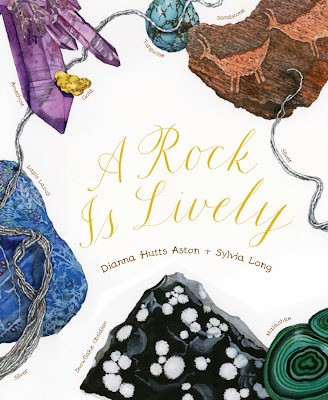
There's a children's book exhibition on in my town and one book that caught my eye was A Rock Is Lively by Diana Hutts Aston and Sylvia Long (affiliate link).

The illustrations are bright and beautiful. The text is hard to classify.

Is it poetry? "Bubbling like a pot of soup deep beneath the Earth's crust ... liquid ... molten ... boiling"

Is it geology? "Depending on what type of rock it is, a rock melts at temperatures between 1,300 and 2,400 degrees Fahrenheit ..."

 However you categorize this book, the illustrations and poetic writing will satisfy your artistic side while the informative text will thrill your inner rockhound.

A Rock Is Lively Cover

August 17, 2013

How To Learn More from Making a Tin-Can Phone

Everybody's made a tin-can phone or string phone as a child. They're fun, they work (Can you hear me? Yes!!!), and they're quick and easy to make. But what can we as parents and teachers do to increase the fun and learning? Read on for the basics of how to make a tin-can phone, and then read some ideas for experimenting for more fun and learning!

photo by Florian Seroussi (CC BY-NC-SA 2.0)

Making a string phone is easy. Here's what you need.

  • Two paper cups.
  • A length of non-stretchy string.
  • Something to poke holes in the cups (a sharp pencil will do).
  • Two paper clips (big ones work best).

And here's what you do.

  1.  Poke small holes in the bottom of your cups.
  2. Poke string through the bottom of each hole.
  3. Tie a knot around each paper clip so that the that the paper clips are inside the cups. This anchors the string and prevents it from pulling through the hole in the cup when you pull the string taut.
  4. Decorate as desired.
  5. Enjoy your phone by holding the string tight between two people. One talks, and the other listens. 

 Then experiment!


My students experimenting with string phones
Kids will probably have lots of ideas for experimenting with their string phones, but here are some to get you started.
  • Make a phone for each person and connect them so everyone has an earpiece and a mouthpiece as in the photo above (They could hear each other well).
  • Try different materials: cans or plastic cups instead of paper cups, different kinds of string or twine.
  • Experiment with the string length. How long of a string can you use before the sound is too weak to hear? The video after this list shows people who really push the limits.
  • Do the people on the phone need to be in a a straight line? Try talking with the string going around a wall corner. How about around the leg of a chair.
  • Will the phone work if the string passes under a rug? What if it's wet? What if someone pinches the string?


Can You Hear Me?: The Longest Tin Can Phone Ever.


What do kids learn from string phones?

Kids often understand intuitively why things work if they get hands-on and experiment a lot, but it never hurts to ask the "why" question and see how much they really understand and what needs to be taught. Depending on the interests and abilities of your children, they can learn about sound waves and what media sound travels through, how signal can be dampened and amplified (maybe focused is a better word). They can also learn some engineering when they try to keep the line tense without it ripping through the cup. Kids can learn about real telephones which operate on the same basic concept, except the sound signal is electronic instead of accoustic. (Here's a page about how telephones work.)

Enjoy your string phones, and if you have questions or ideas for further experiments, please leave a comment!