The first human flight took place in a hot air balloon in France over 100 years before Orville Wright took to the air. It's not easy to make a working airplane, but balloon technology is simple--just heat the air inside a balloon so that the air inside and the contraption itself are lighter than the air that is displaced.
We made our balloon with a thin trash bag, straws, aluminum foil, tape, and six birthday candles, following the excellent instructions from sciencetoymaker.com.
Here is our balloon's second attempt at flight, after trimming some weight from the straws, trash bag, and foil.
A fun way to add some literacy and history to this activity for younger kids is with Hot Air, the story of the first balloon flight with passengers aboard (animal passengers). For older kids, The Twenty-One Balloons a fun mix of fiction, history, and balloonology is recommended.
Enjoy making your balloon, and keep a fire extinguisher or bucket of water handy just in case!
Math is largely about recognizing and creating patterns. But sometimes the best way to practice something is doing the opposite. Hmmm. Is avoiding a pattern another way of creating a pattern?
Take from a deck of cards all the Aces, Kings, Queens and Jacks.
Arrange them in a 4 × 4 square so that every row, column and diagonal
contains one card of each value (A,J,Q,K) and one card of each suit
(Heart, Spade, Diamond, Club). source
It's really tough not to have cards of the same value or suit in any row, column, or diagonal, but look at the sense of accomplishment on the faces of these ten-year-olds who stuck with it and solved the puzzle.
Today I gave my kids the "four fours" challenge. Here it is:
Find a mathematical expression for all the numbers from zero to twenty using common symbols (+, -, x, ÷, √, and !), parentheses, and exactly four 4s. The simpler the expression, the better.
To get you started:
4x4÷4-4=0
4x4÷4÷4=1
I had to teach my daughter what √4 and 4! mean. She was very motivated to learn them because they were a great tool to solve the challenge.
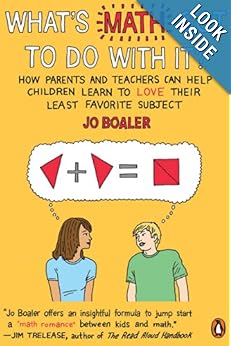
It turns out that "four fours" is a common challenge, but I found it in Jo Boaler's excellent What's Math Got to Do with It?: How Parents and Teachers Can Help Children Learn to Love Their Least Favorite Subject (amazon affiliate link). The book is full of research-backed suggestions for parents and teachers to help their kids thrive in math. Dr. Boaler will be teaching a course called "How to Learn Math" on Stanford University's free online platform. It's from July 15 to September 27, 2013. You can find out more about it here. I'll be taking the course. Please let me know if you will be.
Student assessment can take many forms. One thing I like to do is ask the students to create their own questions, answer them themselves, and share the questions with others.
The raw material I gave the students is from the well-known "Eric the Sheep" problem (Here's another blog about it).
Eric the sheep is lining up to be shorn. He is last in the line. Each time the shearer takes one sheep from the front of the line, Eric sneaks past two sheep to get closer to the front. There are 50 sheep in front of Eric to start with. It takes the shearer ten minutes to take a sheep from the line and shear it. The shearer never takes a break! Each sheep produces 5 kg of wool.
Use the information in the story of Eric the sheep to make up an interesting story problem that you can answer. You don't need to use all of the information.
And here are my students' questions with the their ages (I teach a multi-age class). I had to help a few students polish their questions to get rid of excessive wordiness or vagueness.
1. How many times does Eric pass two sheep? (10 year-old)
2. How many minutes does it take to pass 24 sheep? (10 year-old)
3. After 60 minutes, what place was Eric in? (10 year-old)
4. How many kilograms of wool did all of the sheep provide? (8 year-old)
5. What number is Eric to be sheared? (11 year-old)
6. How many grams of wool were sheared altogether? (11 year-old)
7. How much wool is sheared before Eric is sheared? (12 year-old)
8. How many sheep did Eric pass? (12 year-old)
9. How long does the shearer shear before shearing Eric? (12 year-old)
10. If Shawn, who started at number 34, skips one sheep every time the shearer takes a sheep, who arrives to the front of the line first, Shawn or Eric? (12 year-old)
11. One-third of the sheep are pink, two-sixths of the sheep are vomit green, and the rest are purple. (a) How many purple sheep are there, and (b) how many kilograms of purple wool were there? (13 year-old)
These questions cover all the types of questions I would have asked and then some (number 10!). Some of the students missed their own questions on the first try, but were very motivated to find the correct answer.
This kind of activity is excellent assessment for learning. We can see what the students are and aren't comfortable with, and we can be sure that if their answer is incorrect, it certainly can't be because they misunderstood the question. After all, they wrote it!
Today my students found over 100 words hiding in the word "signature." Most of the kids are English language learners. It was a fun way for them to think about spelling and learn some new vocabulary.
It all started with me pointing out that the word "sign" is the root of "signature," which is a spelling word for some kids this week. A student pointed out that the word also contains "gnat." Someone else found "nature," and we were off to the races.
Right after taking this photo, a student found "granite." Can you find any other words? Add them in the comments.
Citizen science is a fun way to participate in a bigger science project than what one can do at home or even in a lab. Citizen scientists help collect data for professional scientists to analyze--think bird counting or amateur astronomy. Or they can help analyze and report on data that has been gathered by professional researchers.
Scistarter.org is a kid-friendly portal for citizen science. It helps budding scientists find projects based on topics, activities, locations, cost, and more. Some of the projects are gamified to add more elements of fun.
Please let me know in the comments if you've participated in any citizen science projects, or would like to.