
Showing posts with label math. Show all posts
Showing posts with label math. Show all posts
March 3, 2015
Fractal Tree
Fractals are lots of fun. Very helpful for multiplication,
exponentiation, place value, and counting in base two, base three, etc., not to mention art!
Helpful hint: use different colors for each layer.
For lots of other great math ideas, check out naturalmath.com and letsplaymath.net.

October 31, 2013
Ordinal Number Fun - Baseball Lineup Card
Teach with your student's interests in mind.
My first-grade son likes baseball, so when we did ordinal numbers (1st,
2nd, 3rd...), he made his own lineup card. I'm not sure I agree with his
batting order decisions but hey, it's math practice, not baseball
manager practice.


September 24, 2013
Let's Hope They Have Questions

Christopher Danielson is a math teacher and teacher trainer whose blog is always thought provoking for me as a teacher. He turns the "Any questions?" question on it's head like this:
See, in math classes asking questions is usually a sign that you have not learned.
“Any questions?” is a signal to students to speak up if they don’t get what has just been explained.
We have it all backwards.
It shouldn’t be, “What questions do you have?” [I hope you have none so that I can tell myself you learned something.]
It should be, “What new questions can you ask?” [I hope you have some because otherwise our work is having no effect on your mind.]I'm going to apply this right away with my own kids and my other students. Every lesson will end with a variation of "What question do you have that you couldn't have asked before this lesson?"
Read the rest of Danielson's article.
September 16, 2013
Number Line Addition Game with Dice
A friend told me the other day that her first-grade son was discouraged about math. He is having a hard time memorizing addition and subtraction facts within 10. He was calling himself stupid and saying that he was no good at math. How sad to see a little guy developing a math complex.
Anyway, she asked me for some tips. I shared with her a game that I had played earlier in the week with my own son. It's great practice for addition facts within 10, especially plus 1, plus 2, and plus 3, but can be adapted easily to subtraction or to numbers up to 20. It's from Singapore Math's Primary Mathematics 1A (affiliate link).
Materials
Do yo have any recommendations for fun ways to practice math facts? Share in the comments.
Anyway, she asked me for some tips. I shared with her a game that I had played earlier in the week with my own son. It's great practice for addition facts within 10, especially plus 1, plus 2, and plus 3, but can be adapted easily to subtraction or to numbers up to 20. It's from Singapore Math's Primary Mathematics 1A (affiliate link).
Materials
- A number line 0-10 (or 0-20) with squares big enough for game tokens. (We
used Professor Plum and Colonel Mustard from Clue.)
Post-It Notes Turn Dice into Math Dice - Game tokens.
- A die (number cube) with stickers (two each) labeled +1, +2, and +3 stuck onto the sides. Depending on the skill you want to target, you can replace the stickers with -1, -2, -3, or whatever.

- Each players token starts at zero for addition or ten for subtraction.
- Players take turns rolling the die and moving their tokens up the number line by the amount shown on the die. For example, if they are on 2 and roll a +3, they say "Two plus three equals five." If a player lands on another player's spot, the other player's token goes back to the beginning.
- The first player to reach the goal wins the game, or a point. If a player overshoots the goal, the player's token goes back to the beginning.
Do yo have any recommendations for fun ways to practice math facts? Share in the comments.
September 6, 2013
Go Fish! Number Bonds Version
Our youngest is doing Singapore Math 1 this year and is learning number bonds now. Number bonds, are simply sets of three numbers—two parts and a whole—that go together, like 3, 2, and 5. They are usually represented something like this:


When children learn this one number bond, it becomes easy for them to memorize the fact family 3+2=5, 2+3=5, 5-3=2, and 5-2=3. It also helps later to be able to break numbers down to make them easier to work with.
On to the game. My little guy brought out his set of Go Fish cards last night after dinner and we decided to play "Go Fish to Make 10." (We could have decided to make any number.) You've probably got the idea already, but instead of fishing for pairs of identical cards, you fish for pairs that make 10. For example, if you have a 3 in your hand, you ask for a 7. Don't forget before playing to pull the cards out of the deck that won't work. Last night we had to take out the 11s and 12s.

Above is the Numbers Go Fish Game that we have [amazon affiliate link]. The cards are large and sturdy, the numbers are clear, and the pictures are interesting. A regular deck of playing cards works fine too, but I like having zeros and ones (not aces).
It's nice to have another game to practice number bonds and fact families. I've previously written about others like Salute, Eleven, and Number Bonds Dominoes. All you need for these games is a deck of cards or some dominoes. Please share your favorite ways to practice number bonds in the comments area below!
August 5, 2013
Anti-Pattern Recognition
Math is largely about recognizing and creating patterns. But sometimes the best way to practice something is doing the opposite. Hmmm. Is avoiding a pattern another way of creating a pattern?

Take from a deck of cards all the Aces, Kings, Queens and Jacks.It's really tough not to have cards of the same value or suit in any row, column, or diagonal, but look at the sense of accomplishment on the faces of these ten-year-olds who stuck with it and solved the puzzle.
Arrange them in a 4 × 4 square so that every row, column and diagonal contains one card of each value (A,J,Q,K) and one card of each suit (Heart, Spade, Diamond, Club). source

June 27, 2013
Four Fours and Making Math Fun
Today I gave my kids the "four fours" challenge. Here it is:
Find a mathematical expression for all the numbers from zero to twenty using common symbols (+, -, x, ÷, √, and !), parentheses, and exactly four 4s. The simpler the expression, the better.
To get you started:
4x4÷4-4=0
4x4÷4÷4=1
I had to teach my daughter what √4 and 4! mean. She was very motivated to learn them because they were a great tool to solve the challenge.
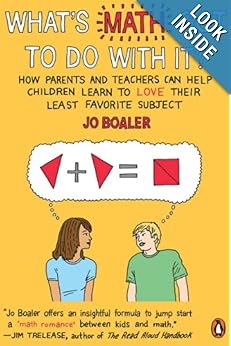
It turns out that "four fours" is a common challenge, but I found it in Jo Boaler's excellent What's Math Got to Do with It?: How Parents and Teachers Can Help Children Learn to Love Their Least Favorite Subject (amazon affiliate link). The book is full of research-backed suggestions for parents and teachers to help their kids thrive in math. Dr. Boaler will be teaching a course called "How to Learn Math" on Stanford University's free online platform. It's from July 15 to September 27, 2013. You can find out more about it here. I'll be taking the course. Please let me know if you will be.
Find a mathematical expression for all the numbers from zero to twenty using common symbols (+, -, x, ÷, √, and !), parentheses, and exactly four 4s. The simpler the expression, the better.
To get you started:
4x4÷4-4=0
4x4÷4÷4=1
I had to teach my daughter what √4 and 4! mean. She was very motivated to learn them because they were a great tool to solve the challenge.
It turns out that "four fours" is a common challenge, but I found it in Jo Boaler's excellent What's Math Got to Do with It?: How Parents and Teachers Can Help Children Learn to Love Their Least Favorite Subject (amazon affiliate link). The book is full of research-backed suggestions for parents and teachers to help their kids thrive in math. Dr. Boaler will be teaching a course called "How to Learn Math" on Stanford University's free online platform. It's from July 15 to September 27, 2013. You can find out more about it here. I'll be taking the course. Please let me know if you will be.
June 19, 2013
Student-Created Math Questions
Student assessment can take many forms. One thing I like to do is ask the students to create their own questions, answer them themselves, and share the questions with others.
The raw material I gave the students is from the well-known "Eric the Sheep" problem (Here's another blog about it).
These questions cover all the types of questions I would have asked and then some (number 10!). Some of the students missed their own questions on the first try, but were very motivated to find the correct answer.
This kind of activity is excellent assessment for learning. We can see what the students are and aren't comfortable with, and we can be sure that if their answer is incorrect, it certainly can't be because they misunderstood the question. After all, they wrote it!
The raw material I gave the students is from the well-known "Eric the Sheep" problem (Here's another blog about it).
Eric the sheep is lining up to be shorn. He is last in the line. Each time the shearer takes one sheep from the front of the line, Eric sneaks past two sheep to get closer to the front. There are 50 sheep in front of Eric to start with. It takes the shearer ten minutes to take a sheep from the line and shear it. The shearer never takes a break! Each sheep produces 5 kg of wool.And here are my students' questions with the their ages (I teach a multi-age class). I had to help a few students polish their questions to get rid of excessive wordiness or vagueness.
Use the information in the story of Eric the sheep to make up an interesting story problem that you can answer. You don't need to use all of the information.
1. How many times does Eric pass two sheep? (10 year-old)
2. How many minutes does it take to pass 24 sheep? (10 year-old)
3. After 60 minutes, what place was Eric in? (10 year-old)
4. How many kilograms of wool did all of the sheep provide? (8 year-old)
5. What number is Eric to be sheared? (11 year-old)
6. How many grams of wool were sheared altogether? (11 year-old)
7. How much wool is sheared before Eric is sheared? (12 year-old)
8. How many sheep did Eric pass? (12 year-old)
9. How long does the shearer shear before shearing Eric? (12 year-old)
10. If Shawn, who started at number 34, skips one sheep every time the shearer takes a sheep, who arrives to the front of the line first, Shawn or Eric? (12 year-old)
11. One-third of the sheep are pink, two-sixths of the sheep are vomit green, and the rest are purple. (a) How many purple sheep are there, and (b) how many kilograms of purple wool were there? (13 year-old)
These questions cover all the types of questions I would have asked and then some (number 10!). Some of the students missed their own questions on the first try, but were very motivated to find the correct answer.
This kind of activity is excellent assessment for learning. We can see what the students are and aren't comfortable with, and we can be sure that if their answer is incorrect, it certainly can't be because they misunderstood the question. After all, they wrote it!
December 9, 2012
20 Foods to Learn Fractions

- Pizza
- Pie
- Quesadillas
- Orange wedges
- Graham crackers
- Bunches of grapes
- Bunches of bananas
- Chocolate bars
- M and Ms
- Heads of cabbage or lettuce
- Pancakes
- Waffles
- Popsicles
- Cookies
- Six-packs of juice or soda
- Bell peppers
- Marshmallows
- Animal crackers
- Jelly beans
- Packs of candy or gum
Feel free to add more foods in the comments.
Photo of Orange by Esther Gibbons on Flickr (CC BY-ND 2.0)
November 28, 2011
Eleven: Fun Card Game for Practicing Math Facts to 20
 |
| Eleven - Fun Card Game for Math Facts |
"Eleven" is my favorite card game to help students practice addition and subtraction facts up to 20. It's for any number of players, and all you need is a deck of cards.
Setup
Remove the face cards and jokers. Count aces as one. Shuffle the cards and place them in a pile face down.
Procedure
The goal of the game is to reach the number 11 exactly by adding and subtracting the value of drawn cards. The first player draws the top card and places it face down next to the pile, saying the number on the card. The next player draws a card, adds the two cards' values, says the sum of the two cards as a number sentence and places the drawn card on top of the pile. The next player draws and adds the number of the newly drawn card to the previous sum. Play continues until the total reaches 11. If the sum exceeds 11, then players subtract the number on the drawn card from the total, and state the difference as a subtraction sentence. Play continues until the sum or difference is exactly 11. If you want to keep score, the player whose card makes exactly 11 gets the whole pile of cards.
A typical game might go like this.
First turn: With a 3 showing, player draws a 4 and says, "Three plus four equals seven."
Second turn: Player draws an 8 and says, "Seven plus eight equals fifteen" (This is more than 11, so the next player subtracts.)
Third turn: Player draws a 3 and says, "Fifteen minus three equals twelve."
Fourth turn: Player draws an 8 and says, "Twelve minus eight equals four."
Fifth turn: Player draws a 7 and says, "Four plus seven equals eleven!" This player takes all of the cards and play resumes again with a new card drawn.
There's nothing magical about the number 11. If you want to practice math facts with bigger numbers, you can play 21, 50, 100 or whatever number you want.
Questions or comments? They are welcome below.
October 16, 2011
Fun Card Game for Place Value
I was recently asked how to teach place value. One fun way to teach about place value is through a variation of the old card game, War. You'll remember that in War, the deck is dealt evenly to all players, the players players flip one card face-up simultaneously, and the player with the highest card takes the other cards. This continues until one player has all the cards.
In Place Value War, which I adapted from a Singapore Math teacher's manual, each player has a place value mat or piece of paper with thousands, hundreds, tens, and ones, written on it. Follow this procedure to play.
In Place Value War, which I adapted from a Singapore Math teacher's manual, each player has a place value mat or piece of paper with thousands, hundreds, tens, and ones, written on it. Follow this procedure to play.
 |
| Click for a printable PDF version of this Place Value Chart |
- Deal all the cards face down. (I recommend using an UNO deck rather than regular playing cards because the UNO deck has zeroes and the ones are proper ones, not aces.)
- Players simultaneously flip one of their cards face-up, decide where to place it on their chart, and state their choices. ("Seven hundreds" or "three ones.")
- Continue until all places on the paper are filled, then each player says the number that is on his paper. ("Seven thousand, five hundred, twenty-three.")
- The player with the highest 4-digit number wins the round and takes the other players cards.
- Continue play until one player has all of the cards.
This game naturally teachers place value because players soon realize that, for example, a 3 in the hundreds place is greater than a 9 in the tens place. Unlike regular War, Place Value War includes strategic thinking about probability. ("Should I place a six in the thousands place on my first draw or hope for a higher number?")
Of course you can adjust the game to include more or fewer places on the paper. To increase the suspense, I sometimes have the players take turns instead of flipping cards simultaneously. Enjoy the game, make up your own rules, and share your experiences or suggestions in the comments.
You may also be interested in How to Teach Math with UNO.
October 11, 2011
Use a Ruler As a Number Line

In math, primary students begin with concrete objects, progress through symbols, and arrive at abstract concepts of numbers. A number line is a great tool to help them along this path. Sometimes we forget, but a ruler is a perfect number line. Here's why:
- A ruler goes from zero to twelve or thirty, depending on whether you are looking at the inch side or the centimeter side.
- A ruler is in most kids' desks or pencil cases already, so there's no need to print out a paper number line and laminate it. (Having said that, if you do want a printable number line, there are several to choose from.)
- A ruler is concrete in the sense that it's a real thing that students can touch.
- Bonus! A ruler leads gently and naturally into fractions and decimals. ("Teacher, what are the little lines for between the numbers?")
So don't just use that ruler for measuring things and drawing straight lines. Use it for counting (including skip-counting), adding, subtracting, and introducing decimals and fractions.
Do you like the ruler in the photo above? Here is a link to that classic, brass-edged 12-inch wooden ruler on amazon.
Question: In your teaching, do you use objects in ways other than their "real purpose?" If so, please share in the comments.
Question: In your teaching, do you use objects in ways other than their "real purpose?" If so, please share in the comments.
September 17, 2011
Math Game: Use Dominoes to Practice Number Bonds
A fun, hands-on math game to practice number bonds, or fact families, is with dominoes. First choose a sum that the dominoes must add up to. I usually use the number ten for double-nine dominoes.
 |
| "Dominoes" by Becky Bokern |
Then place all of the dominoes face down and mix them up. Turn one domino face up. The first player draws a domino and if one of the sides of her domino plus one of the sides of the face-up domino add up to ten, she places her domino next to the face up domino and says, for example, "six and four make ten." Whether she can play her own domino or not, play passes to the next player. This game starts slow sometimes, but it picks up quickly and students end up scanning the table for all possible number bonds that add up to ten.
What I like about this game is that it is fun for any number of players, correction is immediate because the other players are watching, players are thinking mathematically while waiting for their turn, and once several dominoes are on the table, there are several possible correct answers for each turn.
Another fun game to practice number bonds is Salute. Also be sure to check out a page full of math games to play with UNO cards.
Question: What are your favorite games to practice math facts? Please share in the comments.
August 29, 2011
Salute: Quick, Fun Card Game to Practice Math Number Bonds
It's back-to-school time and children's math skills have become rusty. Try Salute, a quick, fun card game to practice math fact families, sometimes called number bonds. It's a game for three: a caller and two saluters. The caller deals cards out face down to the two saluters. When the caller says, "Salute," the saluters each pick up a card without looking at it and hold it face out on their foreheads. The caller looks at the cards and calls out the sum (or the product if you want your students to review muliplication/division fact families). The first saluter to say the card that is on his or her own forehead wins the round. Students can review a lot of math facts quickly with this game, and they are quick to confirm each other's accuracy.
Salute can be played with regular playing cards by treating aces as ones and either considering face cards as tens or culling them out of the deck. I prefer to play it with Uno cards, because the numbers are more prominent and there is no counting of hearts, clubs, spades or diamonds. Just cull the reverses, skips, and wilds.
 |
| Salute with Uno Cards |
For more math card games, check out How to Teach Math with UNO.
Question: Other than worksheets, how do you practice math facts with your students?
Subscribe to:
Posts (Atom)